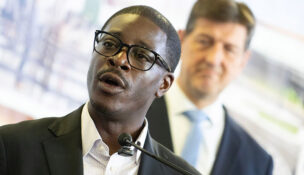
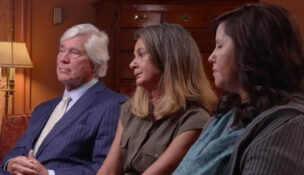
“It makes it difficult for someone running for judge to have a political endorsement hanging around them. You’d just be hurting them. If I were a delegate, I wouldn’t do it.” — Former Gov. Al Quie |
With two Minnesota Supreme Court justices on the ballot in 2008, the controversial topic of judicial endorsements seems a likely subject of debate at this year’s state Republican Convention.
In fact, delegates are required to at least talk about it, according to Minneapolis attorney and party activist Erick Kaardal. The Minnesota GOP’s constitution specifically calls for a majority vote on whether or not an endorsement will be considered for a particular office.
The GOP’s Judicial Election Committee has been looking into the backgrounds and decisions of the two high court justices and seven Court of Appeals judges up for election this year, and plans to report its findings at the convention, according to Republican activist Bonn Clayton.
There is a major split in the party as to whether endorsements are appropriate for judicial races. Supporters argue that endorsements provide the public with valuable information about judicial races and help ensure that no “activist” judges are elected. Opponents argue party endorsements run the risk of politicizing Minnesota’s historically nonpartisan judiciary, and are frequently made with little or no good information about the candidates.
Meanwhile, the DFL has steadfastly declined to endorse judges because of concerns about the potential politicization of political races.
Judicial endorsements by political parties are generally unpopular in the legal community, with many judges and lawyers on both sides of the aisle disfavoring the practice. They contend party endorsements needlessly infuse politics into judicial races, potentially compromising the independence of the judiciary and its reputation for impartiality.
“I think if there were such as a thing as a Republican bar, it would be against judicial endorsements,” says Brent Robbins, a Republican lawyer who works at General Mills. “We don’t want politicized judicial elections like Texas or Ohio.”
Wisconsin also recently had a highly politicized race for its Supreme Court, with special-interest groups dumping millions of dollars into the campaigns.
Ironically, Robbins was a member of the GOP committee charged with making recommendations on judicial endorsements in 2002 and 2004. He wound up opposing endorsements, believing that the information available was not sufficient to justify making them.
Robbins says most party members either don’t want endorsements or don’t care, but a small, powerful group within the party has successfully lobbied for them in past elections. (In the 2006 election cycle, for example, the state GOP endorsed Justice G. Barry Anderson for Minnesota Supreme Court, despite the justice’s request that the party not do so. Anderson, who opposes party endorsements of judges, declined to use the endorsement in his campaign.)
Kaardal, on the other hand, maintains that party endorsements are meaningful, and says that if a good candidate is running for a judgeship, the party would be “lacking courage” not to endorse him or her.
Both Supreme Court candidates running for election in Minnesota this year were appointed to the bench by Republican governors. Justice Paul Anderson was appointed by Gov. Arne Carlson in 1994; Justice Lorie Gildea was appointed by Gov. Tim Pawlenty in 2005.
Kaardal says he expects that both incumbent high court justices would “easily” be endorsed if delegates vote to go ahead with endorsements.
Independence vs. elitism
The state GOP was a plaintiff in a landmark lawsuit that established judicial candidates had the right to use party endorsements in their campaigns. Prior to a U.S. Supreme Court and follow-up 8th U.S. Circuit Court of Appeals decision in Republican Party of Minnesota, et al. v. White, et al., the use of such endorsements was prohibited by the state ethical rules governing judicial campaigns.
Despite the state GOP’s participation in the federal litigation, there are many in the party who feel the party should refrain endorsing judicial candidates.
Former Gov. Al Quie says he hoped delegates would not endorse any political candidates this year. A party endorsement makes a candidate appear in the public eye to be partisan, even if he or she is not, he explains.
“It makes it difficult for someone running for judge to have a political endorsement hanging around them,” Quie says. “You’d just be hurting them. If I were a delegate, I wouldn’t do it.”
Quie spearheaded a commission that considered whether Minnesota’s system for electing judges should be revamped. The group ultimately concluded that the state should switch to a retention system for electing judges. Under such a system, voters would decide whether or not to retain an incumbent judge rather than chose between the judge and a challenger. The proposal requires a constitutional amendment, but lawmakers did not act on it in their recently completed session.
The election proposal was designed as a means for Minnesota to avoid an experience like Wisconsin’s.
“Minnesotans would be wise to make the switch to retention elections now,” before judicial selection becomes embroiled in partisanship, says Minneapolis attorney George Soule, former chair of the Commission on Judicial Selection, in a recent article published in the William Mitchell Law Review.
However, Kaardal, who opposes changing the judicial election system, argues that it smacks of elitism and lessens the role of the people in the selection of judges.
Clayton says the Republican platform supports the current judicial-election system. (He does nonetheless advocate adding a provision to the GOP platform specifically opposing the idea of retention elections). Clayton also supports the addition of several other judicial-election items to the platform, including language favoring the elimination of the “incumbent” designation from judicial ballots and requiring that all newly created judicial seats be filled by election. He also would like language added advocating for:
• Having governors appoint only judges who pledge to serve their full six-year term.
• Making judicial elections county-wide rather than district-wide.
• Making judicial ethics statutory rather than court-created ethics rules.
• Establishing limits for contributions to judicial campaigns.
Minnesota is no California
Some predict that the judicial endorsement issue has the potential to be particularly “hot” this year because of the recent California Supreme Court decision overturning the state’s gay marriage ban.
Those most vocal with their concerns about “activist judges” are usually referring to rulings in cases involving social issues such as gay marriage and abortion. The California case could have a backlash here, even though Minnesota courts have been fairly conservative in using their judicial power, several lawyers predict.
However, lawyers and other court watchers say they have seen no indication that the Minnesota Supreme Court plans to wade into the gay-marriage debate as the California high court has.
In some states, business interests decry activist benches that they see as being pro-plaintiff and, therefore, anti-business. In Minnesota, the U.S. Chamber of Commerce has consistently given the Minnesota courts high marks, naming them second best in the nation in terms of “fairness of litigation environment” in 2007.
Additionally, there have been no DFL appointments to the bench in nearly 18 years. Five of the seven sitting state Supreme Court justices were appointed by Republicans (four of those by Pawlenty). The sixth justice was appointed by Independence Party Gov. Jesse Ventura. The seventh justice, Alan Page, obtained his seat on the bench through election rather than appointment.